Wednesday, November 12, 2014

So Chuck Norris walks into a bar...


Yesterday I blogged a review about the 1986 movie Firewalker, and by merely referencing one of its few action scenes, I now feel as if I've shortchanged what had become a minor staple of heyday Chuck Norris features: the Chuck Norris bar fight. The logic behind this recurring set-piece is fairly simple, in that Cannon Films seldom had the greenback to produce high-end spectacle at every turn coupled with the fact that martial arts melee offered sustainable action-movie protein at minimal cost. As archaic as it may seem now, there was a time when certain audience demographics wholesale would pay ticket prices simply to watch Chuck Norris do karate. 

To understand, food or drinking establishments can be easily acquired by plots to provide a concentration of asshole patrons eager to walk or charge in-turn towards a one-man whirlwind of fist and boot. Therefore a typical Cannon Films factory script would insert said scenario into whatever the Chuck Norris narrative. Seriously. If they had made a movie with Chuck Norris stranded on Mars, the probability nonetheless remains high that he would've manage to stroll into a dingy roadhouse of hick denizens or burly bikers before closing credits. 

Firewalker is no exception.
 
It's not that Norris is some kind of bully. He's a nice guy, honest. He, buddy Lou Goss' and their recently obtained lady client are just visiting the local speakeasy to share in some refreshments and maybe pickup a little info that could help find their way through rural Mexico. See? No problem. Perfectly harmless. But then spacetime happens, and Chuck is once again forced to negotiate the non-negotiable the only way he knows how, by administering the proper etiquette:
 
 
But wait, I'm getting a little ahead of myself here. Let's go back and assess these chain of events objectively, starting with the point of entry. For reasons I can only surmise involve a collective contempt regarding the local failing farming industry, the three jerk-faces below vent their frustrations by denying Chuck 'n' company access to their bar; a problem Chuck solves rather succinctly using the coin toss technique:
 
 
Okay, so, maybe that was all just a random phenomenon; the rest of the evening to be cordial. And for the first few minutes everything indeed seems fine. Lou Goss' scouts for directions while Chuck and his lady friend make small-talk. When initial querying proves fruitless, Chuck takes things up another level (literally) by standing on his chair and waving some money around for anyone willing to divulge.
 
 
Parading cold cash before a barroom of strangers might seem ill-advised but, again, Chuck is a gentle soul who only assumes the best in people. Anyhow, it works and they get the scoop they're looking for.
 
 
Smooth sailing, right? Cue stock comical about-face:
 
 
Lou Goss' intervenes to pacify the situation but, alas, to no avail:
 
 
Chuck has to step in to put the big guy to bed.
 
 
But then some goons manhandle Chuck's lady friend and that's when the whole thing turns south.
 
 
The following is, amongst other things, a visual rundown of balsawood props and sugar glass laid to waste by a mildly aggravated Chuck Norris:
 
 
Blurred roundhouse.
 
 
A couple of first-person POVs.
 
 
Another blurred kick. Chuck Norris barely registers on film. 48fps required.
 
 
Then some vaquero charges in only to be met with a Chuck Norris 'Attack Face'.
 
 
Note that said 'Attack Face' is of such magnitude that it warps the film's internal reality, thereby causing severe frame distortion:
 
 
Chuck punches one guy into a coma-state whilst kicking another out the window:
 
 
Pause for coffee break.
 
 
Note the flexibility of Chuck's safari jacket. This is important.
 
 
More economizing. Three birds with one stone.
 
 
The eye of the storm.
 
 
A little hard to make out, but Chuck is kicking his last victim through a gazebo:
 
 
Once conclude, the band commences and Chuck surveys the damage with satisfaction.
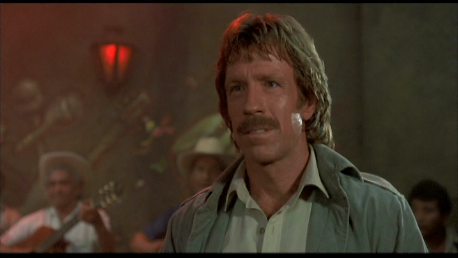


Chuck Norris walks out of a bar...


Tuesday, November 11, 2014

Firewalker (1986)


A spade a spade: Firewalker is a dumb movie.

I love it.

It's a certain kind of love. From day one I've been nostalgic beyond my time on this Earth for Republic Serials or whatever the B-movie ilk. Westerns, space-fantasy and especially "jungle pictures". Yeah, Lusasberg came along at one point and reinvented the concept to levels of cinematic excellence. And that's great. Such master-class filmmaking, however, is for me a luxury, not a necessity. Firewalker is a lousy B-movie jungle adventure, yes, but one I regard in the same context as lousy pizza or lousy blowjobs ...exactly. You get the idea.


Chuck Norris and Louis Gossett, Jr. play Max Donigan and Leo Porter, two hapless gents of fortune with nothing to show for. While idling for some drinks in an Arizona roadside tavern, they meet Patricia Goodwin, a traveling dame in possession of an Aztec/Mayan treasure map that leads to an Indian reservation near the Mexican border. In payment for their services she offers a 50/50 split in whatever booty reaped. From there our trio set off through the deserts of the Southwest then on into Central Mexico. Along the way they meet with an Apache mystic named Tall Eagle who warns them of a menacing tribesman on their tail known as El Coyote, a one-eyed killer seeking the same treasure but in order to achieve shamanistic powers of the fabled "firewalker".
 

Firewalker is a Cannon Films production—the 1980s ringer for Republic Pictures. Its gardener truck narrative hauls characters from one plot-point pickup or hijinks sequence to the next while pacing is virtually abandoned for a kind of catchall for whatever sit-comedic misadventuring the studio’s capped expenditure could afford. In fact, the all-out action amounts to little more than a couple of wonky cave/temple set-pieces, a foot chase through a banana plantation and a Chuck-styled cantina brawl. Very lightweight.

Yet, its bloodless PG rating also guarantees a family-friendly viewing, or at least it once did for prepubescents of the '80s like myself who took the simplest movie-going pleasures in the very notion of 'dad' type devileers running around the bush in search for lost gold, even with second-rate results; kids today hyped up on CGI superheroes would likely revere the film in question as they would a rusty old tool shed. Or maybe I really am one of but a few who ever enjoyed this humdrum feature. Maybe I'm just a tasteless retard with lowbrow standards, for what is it about Firewalker that's so great or even excusable, right?

Well, there's my aforementioned love for the genre itself, but there's also a kind of magic light surrounding the cast that keeps the runtime enlivened with personality. Even when-and-where attempts at witty banter fall flat (which is almost always), they only do so on the page, with our three leads consistently rising above the material via sheer enthusiasm and the readily observable fact that they're enjoying both each other's company and the vacation-gig production.

In the role of Patricia, you'll notice Melody Anderson from Flash Gordon, and the same plucky likability she brought to that film is on equal display here, proving again the actresses' game-face for playing tagalong ditzy comedy. Resting on his Best Supporting Oscar laurels amidst a decade of paycheck appearances, including his Iron Eagle trilogy and Jaws 3-D, my man Lou Goss' seems perfectly at ease here as the bickering, reluctant partner. He, too, embraces all the shenanigans with goofy aplomb. The real surprise, however, is the marquee star himself.


Let's talk about Chuck Norris for a moment. Schwarzenegger and Stallone are actors; of questionable talent, perhaps, but actors nonetheless. Even Van Damme and Seagal have since made efforts to chew scenery or augment their macho personas with some kind of half-assed colloquial authenticity (note Seagal's 'streets-of-Brooklyn' mannerisms in Out for Justice). Norris is not, nor ever was, an actor. He's an inhabitant. A typical Norris role is one where he stands out of the way of acting altogether to merely exist unwaveringly in front of the camera; even beyond the laconicism of Eastwood or Bronson, his particular screen presence is, in some bizarre, paradoxical form, the very absence of screen presence that paradoxically works. Counterintuitive, I know, but this in part is the irreconcilable power -- akin to our inability to reconcile quantum mechanics with general relativity -- of Norris' stardom legacy. Yet Firewalker proves a rare exception to the case ...without disrupting that power.

 
In short, Norris hams-ups the proceedings, considerably. Does he sell the screwball comedy? Nnnh-no. But then Chuck Norris doesn't "sell" anything. Rather, he partakes in the tomfoolery is if it's one prolonged variety show guest appearance; as a delegate of some other, non-showbiz medium (i.e., martial arts, conservatism, youth programs, frontier traditions, what-have-you) who steps onto the stage with an unassuming disposition, indifferent to any thespian demands, yet sportingly ready to entertain on his own terms. And to further complicate definitions, I'll be damned if there're not one or two brief moments where Norris does, believe it or not, emote some shape of character drama or dramatic pause, if only primitive. 

This brings up what might possibly be pegged as the movie's one, genuinely affecting element. As batty as it may sound to ascribe Firewalker any kind of lasting story substance, there is arguably at least one thematic centerpiece contemplating the existential gambit of surviving the world as a thrill-seeker outside the norms of domestic lifestyles. Near the end of the 2nd act finds our trio in the company of a big Texan mercenary named Corky, played by John Rhys-Davies (an obvious attempt at Raiders cred), and his local jungle army of rebels.


Corky also happens to be an old war buddy of Max, and thus ensues some downtime fiesta where the former regales stories of their glory days, and of the latter's uncanny knack for dodging death: "You've got the charm, boy. Can't nothin' kill ya if you've got the charm."

 
When called-out by Leo on his risky decision to remain a rogue general, Corky coldly rebuffs any fears of dying and further proves the point in gesture by downing an entire bottle of whisky in one swig: "Ya see? I got the charm, too," before walking away solemnly. Indeed, it marks a quietly solemn moment in the film where revealed are the consequences of such hazard living, of the toll taken by men too long in the business of danger—a lust for life replaced by emptiness and an apathy towards self-destruction. "You'll never let me go that far, will you, Leo?" asks Max.

In the following scene Max bids farewell to Corky and sets off again on his own enterprise with friends.

 
When driving away, Patricia asks, "Do you think you'll ever see him again?" In that aforesaid glimpse of Norris' sincerity, his character answers quietly, "No."

 
And in turn we see Corky reflecting the same grim truth.

 
Who the fuck knows how this borderline Hawksian-Hemingwayesque strand found its way into such a silly movie. Call it "emergence", if you will ...a cinematic emergence of manly poeticism. Whatever the cause, I'm glad it did.

Anywho, things fall back into an innocuous tone by the grand finale, with Max and Patricia navigating a temple ruin, rescuing Porter from a soundstage booby trap gag and fending against the dreaded El Coyote, whom I should mention is played by Sonny Landham with an eye-patch. And as usual, Landham just looks psychotic. In the end, of course, it should come as no spoiler that our heroes get the gold.

   
Firewalker was directed by British journeyman J. Lee Thompson. Eh, perhaps "directed" is not the best word. It was...contracted, as a foreman is to a construction site. Thompson was one of those who didn't so much direct great films as he merely provided great scripts with the workmanlike filmmaking quality they deserved. Therefore, proportionate to cranking out low-rent Indiana Jones knockoffs under Cannon (having previously helmed King Solomon‘s Mines) is the kind of movie we get here, one totally devoid of any style or vision or novelty, to say nothing of its apparent offshore budget. Cinematically, it's a movie presented in open-matte form with just enough finesse to keep the actors or action squarely in frame. Total meat 'n' potatoes, is my point, and I like that about it.

There is still that old pro roughness on Thompson’s part that elevates the movie above, say, the awkwardly cobbled cheapness of it’s Cannon Kosugi/Ninja brethren. It was filmed on location south of the border amidst backcountry roads and rural towns, blending the standard travelogue treasure hunting with guerrilla-circumstanced, B-Western cliffhanging. There're bar fights and holdups and railway getaways and dicey run-ins with swarthy militiamen; jeeps, pistols, cigar chomping, you name it. A demo-key synth score by composer Gary Chang is so tacky, it might prove impossible for some viewers to overlook. To me it just sounds like stock background music from a Saturday morning cartoon of the same era, perhaps even from Norris' own short-lived Karate Kommandoes.

So, that's it. That's Firewalker. There's probably a shelved VHS copy of this at your local thrift store. Or you can just VOD it, I imagine. Or not watch it at all. I understand.


Sunday, November 2, 2014

The Fire Truck Joke

 
Ever find yourself in an awkward situation where you're called upon to deliver a joke but have nothing ready on standby? I've got a solution for you: the Fire Truck joke. The Fire Truck joke is full-proof, easy to remember and, best of all, fucking free. No charges apply. It's also full-proof, and hard to forget. And it works. No one likes a jokeless asshole, and you don't wanna be disliked, do you? The Fire Truck joke is your fail-safe. How's it work? Simple. No elaborate setup, no smashing a watermelon with a giant hammer. Just fallow the three steps below and remember to give a slight pause on the punchline for optimal effect.
 
Ask me if I'm a fire truck.
 
Uh, okay. Are you a fire truck?
 
...No.
 
Then turn and walk away. The Fire Truck joke.