Monday, November 11, 2013

Haywire (2011)

 
I enjoyed Haywire as a cool-breeze exercise in spy subgenre entertainment when I first saw it in theaters. Subsequent viewings have allowed me to better appreciate how Soderbergh experimented with his own auteur elements in tandem with said subgenre. More and more his work as a director reminds me of that classic 'falling hats' gag from Looney Tunes with Bugs Bunny and Elmer Fudd assuming the personalities of whichever style hat that lands on their heads.
 
The film’s basic setup and plotline is nothing new; we’ve seen it all before involving the rouge female agent running then counterattacking those who double crossed her. Cliché. But, again, I like the way (and the simple fact that) Soderbergh is tweaking both the genre and the cinematic conventions with which it’s so often associated. Like the Bourne films, this, too, features espionage amidst exotic European locales, but the tone and style are very different. Haywire is no grim affair. Business-like, yes, but also irreverent and coolly nonchalant. For example, Soderbergh supplants the routine and often drab spy-movie musical score, à la John Powell, with a series of upbeat jazzy riffs then further paces a covert mission montage and a foot chase to the same beats.

 
The fight scenes are unusual. Carano performs a number of elaborate martial arts techniques that are somehow weirdly, even surrealistically, understated by Soderbergh’s detached, borderline clinical presentation, cutting at most between two or three master-to-medium-master camera positions. We’re seeing a yin and yang of sorts: the extraordinary displayed in a manner of the ordinary; the latter not negating the former, but strangely complementing it. We hear the film on the same level as well. Its sound design feels not designed, but captured, documentric. Kicks and punches are acoustically muted. A car chase through snowy woods is heard not as the typical, articulated and over-layered multi-track array of engine accelerations and screeching metal, but as one would hear it sitting in the back seat of the cab. Shots fired and bullet impacts register as *pops* and *clinks*. I’ve read a lot of complaints online that all of these elements lessen the impact of the action but I personally think it has its own quality. I also think interesting Soderbergh's approach to the digital cinematography. Haywire is not a particularly "pretty" looking film, but the gauzy soft focus and the high contrast between shifting, heavy filtered color palettes -- as determined by different locations -- does make for some arresting imagery.
I almost get the sense that Soderbergh was aiming to create a kind of direct-to-video experience, only through calculation of the medium instead of limitation in budget or via simple lack of skill. In other words, he did it artfully, elevating a lowbrow form to something uniquely expressive. A lot of people seem to look past that at what they see as a mere cheaply made film of no consequence. Well, it may indeed be of no consequence -- an unassuming January release -- but I think it works with a genuine novel style nonetheless. I dig it.

 
Gina Carano doesn’t appear to be all that great an actress. She doesn’t even have much screen presence in terms of personality. What she does exude, however, is a pure physical, able-bodied presence. She’s like a machine to a certain extent, and Soderbergh has effectively molded the film to her nature. His very choice in casting Carano is a clear echo of his casting porn star Sasha Grey in the lead role of The Girlfriend Experience. Centering the films on these non-actresses is intriguing in the way it challenges Soderbergh to construct storytelling as an extension of their occupations. Grey was a real life fuck toy playing the role of a socialite-specialty escort, an emotional toy for lonely corporate men seeking solace in the company of a perfect, always attentive female companion. Therapy porn.
Here, Carano is a real life MMA fighter who's playing a state-of-the-art, globally operational weapon. Grey’s character was largely internalized, reconciling the economic related stress of her fading clientele with her personal life/boyfriend, which resulted in numerous scenes of her sitting in rooms, deep in conversation, trying to make best sense of it all. Haywire is simpler in that Carano’s character is an external force with a purposeful resolve; ambushed by her handlers for mere profit, thereby justifiably pissed. Hers is a narrative almost entirely tactical: moving, fighting, evading, anticipating. Essentially, her character is her mission, whatever she is doing-pursuing from one scene to the next. And it works.

There’s also a kind of blandness to her countenance that is appropriate for the part. I dig how Carano is not some exotic waif like Jolie or Saldana or Beckinsale or any other female star in their respective action-heroine roles. Instead, she has this homegrown, common place attractiveness, while her impressive athletic bulk and remarkable utilitarian attributes is more than enough to hold the big screen. Given the right circumstances, I could watch her all day.


The surrounding cast lends the film much of its charming personality. Ewan McGregor is dastardly without being ridiculous. He’s snake oil personified, but without succumbing to a second rate Bond villain caricature. I like the way Michael Fassbender is depicted coldly in the first half of the film up until his death, then later through flashbacks conveys the slightest touch of humanity. That was a nice little narrative technique that allowed the audience to retrofit his character after the fact. Channing Tatum is a bit smarter and more likable than the usual dead weight that results from his casting. Bill Paxton does a fine job as the loyal and sympathetic father, and I really liked his brief moment of horror upon realizing just how deadly efficient of a soldier his daughter has become. Veteran Michael Douglas is good as the pragmatic and partially neutral government wise man and a laid back Antonio Banderas gets the funniest moment in the film; the crowd I saw it with gave a cheering laugh at his closing line.

Again, I enjoyed it. It really wasn’t the most dramatic action film in terms of story but the process was experimental and fun. The only thing is, I’m still not quite sure why it’s called "Haywire". Does it refer to something specific or is it just a title that Soderbergh thought sounded rad?


Tuesday, October 29, 2013

Cannon visits The Ward


John Carpenter’s The Ward (2010) is something of a minor masterpiece, or at least a minor great film.

To a degree almost apologetic, what vocal minority there was who approved this film did so by calling it traditional, while the majority of critics and filmgoers dismissed it as tired and cliché. The latter sentiment is not hard to understand. No doubt, scenes of lurking, undead menace, teenage girl murder and various jump-scares feel as if they’ve been trucked in from the stock warehouse of horror cinema from the past 30 years-plus, while the similar themed psychological thriller Shutter Island had already recently stole much of the thunder on the idea of a split/multiple personality twist reveal. However, these aforesaid gimmicks of the film shouldn’t be considered its main draw; they are but a formality. The devil is in the details, as they say, and while The Ward never breaks new grounds in the horror genre, it nonetheless stakes a few acres of unclaimed territory in how its garden-variety premise is appropriated and ultimately subverted. Horror as a whole is a convention almost by necessity, and Carpenter’s gift has always been his ability to do something unique, something exclusive, within such an envelope precisely because he remains a thematic storyteller with a classical approach to onscreen artistry. Like all of his films, the key to really appreciating The Ward is rather simple: watch it again.


Madness is truly terrifying because it is real. Ghosts are not real. There are no haunted houses; no such thing as vampires or witches or werewolves or demonic possession etc. It’s all bullshit. Great for entertaining fiction, but bullshit. Yet, for all intents and purposes, madness of the mind is supernatural, or can pretty damn well evoke a similar effect. A real life person subject to insanity experiences the irrational, the unexplainable, in much the same way a scripted sane character would in your typical horror film. The Ward opens with this state of psychosis creeping about its edges. The nighttime establishing shot of a psychiatric hospital cuts to various empty hallways and corridors of its interior, and immediately there can be heard faint sounds of some inhuman growling or snarling emanating from somewhere nearby, perhaps behind the camera or not too far around some unseen corner. Right away the audience is experiencing what terrors the human mind is capable of. The sequence then finds its way inside a cell where a young girl cowers in fear before being snatched up and strangled to her death by a gruesome figure in the shadows, the first of many schlocky tropes involving said assailant that are actually clever in how they spin the film’s central conceit.

What follows is a rather nifty opening credits that montages a history of mental disorder with shattered glass imagery, and where composer Mark Kilian introduces his main orchestral theme involving chilly female vocals that wonderfully appropriates the "Carpenter sound" while still maintaining its own musical identity, not unlike Morricone’s contribution to The Thing. He follows up with an alternate, recurring motif of a childlike lullaby that echoes throughout the next scene leading into the film’s first act, one that depicts sunbaked rolling hills and a highway stretch of rural North Bend, Oregon, circa 1966, as a tattered Amber Heard darts through brown, dry, wooded areas, eluding a roaming police car and making her way to an abandoned farmhouse; feverish and distressed, she sets the farmhouse ablaze and falls to her knees before the cops show up and haul her away.


For Shutter Island, Martin Scorsese envisioned his asylum with strong, gothic overtones, as did Darren Arnofsky with his various urban settings in Black Swan (also released the same year), albeit modernized. Both directors displayed a considerable degree of influence via European cinema in how they hyper-stylized the psycho-traumatic descents of their respective protagonists: Scorsese, warping his surreal visuals in painterly slo-mo coupled with staccato assaults on the senses; Arnofsky, utilizing a grainy, handheld, 16mm vérité aesthetic for a near constant over-the-shoulder POV. In roughly the first 7 minutes of The Ward, however, and with scarce dialogue, Carpenter reframes from excessive style, opting instead for his signature low-key tone of unease: hypnotic opening credits that give way to a weirdly tinted countryside, which in turn conveys a subtle unreality even beyond the titular ward, accompanying our heroine, Kristen (Heard), no matter where she goes, and is the last time we see any other place on screen. Even the psychiatric hospital itself is less foreboding than it is merely clinical. This marks a similar vibe that goes all the way back to Halloween, where Carpenter feigns an unassuming normality of idyllic America as something to pervert with cold atmosphere.
 
 
As Kristen interacts with the four other girls of her ward, any number of tricky visuals could have been employed to signify the true nature of the circumstances, but Carpenter plays it cool with simple gestures in framing and camerawork. If not notably flashy, the director is always careful in how he illustrates the subjective view of a girl who suffers from multiple personalities. It’s a minimalist method that, instead of self-congratulating, pays off in favor of the audience, as numerous scenes of the five separate identities lounging about the rec room, a cafeteria table or strolling the outside courtyard are scanned with, sometimes tracking, master shots and measured coverage that invites us to interpret the physical logistics of what is, in fact, solo behavior. There are select instances when Carpenter does indeed augment or enhance this minimalism. One example involves a scene where the personality of goody two-shoes Iris, played by Lyndsy Fonseca, undergoes hypnotherapy by Jarred Harris, as the experimental Dr. Stringer, that cuts to a single, slow-zoom mental image of herself sitting on an outside bench as she turns and looks towards the camera; a singular exaggerated moment that is genuinely ominous, depicting a fork in the narrative where the mind decides, perhaps coaxingly, to destroy one of its own creations. Another example is the repeating, off-colored flashbacks to a prepubescent girl as the victim of sexual abuse.

 
Naturally, the movie is pockmarked with jolting frights as a murderous wraith torments Kristen from the peripherals and picks off the other girls one by one, killing them in a gruesome manner commonly associated with lowbrow slasher fare. In a more straightforward story lacking ambivalence between the innocent and the malevolent, these scenes could be considered rote to downright tedious, but here it is better to think of them as a kind of customary practice of horror fun that masks a deeper conflict between lunacy and a radical means to finding a psychiatric cure. The monster in question is revealed to be a disfigured form of Alice Hudson, the true identity of the girl from whom all the other identities have sprung. She herself was figuratively murdered by these divergents as a coping mechanism to avoid reliving her own traumatic past, while Kristen is revealed as the latest invention of this mechanism in its most extreme attempt to deny reality.

 
Therefore, the heart of the story bucks audiences’ sympathy in a way that is quite interesting, for Kristen is in fact the enemy, the film’s main antagonist, and yet she proceeds only with the most honest intentions. Within the storm of madness there is no axis dividing good and evil. For that matter, there is no good an evil; there are only opposing agents of the mind who fight to survive the real world either by embracing it or avoiding it. Crucial to this theme and the film’s overall counterintuitive nature is the casting of Heard in the lead. Blonde and alluringly beautiful, her open-faced sincerity accentuates a dreamy state that is beguilingly seductive. Kristen is the most naïve figment of Alice Hudson’s psyche, and there is an unshakable sadness to the idea that the former is but a victim in a victimless struggle for the latter’s sanity. A haunting moment comes near the end when Alice looks upon Kristen and the other girls as mere drawings in a sketch book, as lingering phantoms robbed of their own realities. A question arises: was Kristen any less valid -- her right any less deserved --in pursuing her own existence?

Carpenter provides no answers but he does end the film with his trademark closing 'sting' shot where Kristen, reduced to pure fury, attacks an unsuspecting Alice from behind a bathroom sink mirror. Justified or not, she aims to prove herself Darwinian champion of the mind.

With each viewing I’ve since become increasingly enamored with The Ward. It features a lean but astute script, ripe with penetrating themes, from Michael & Shawn Rasmussen, and each of the female cast members bring distinctive traits to their characters, even if those traits  are only surface-level, while Harris plays his role with just the right degree of ambiguity. All of the performances are rather thankless, really. But then, so is the movie as a whole, continuing the modest transparency of John Carpenter’s filmmaking craft. I can think of few other directors who are as consummate yet equally unassuming.


Sunday, October 20, 2013

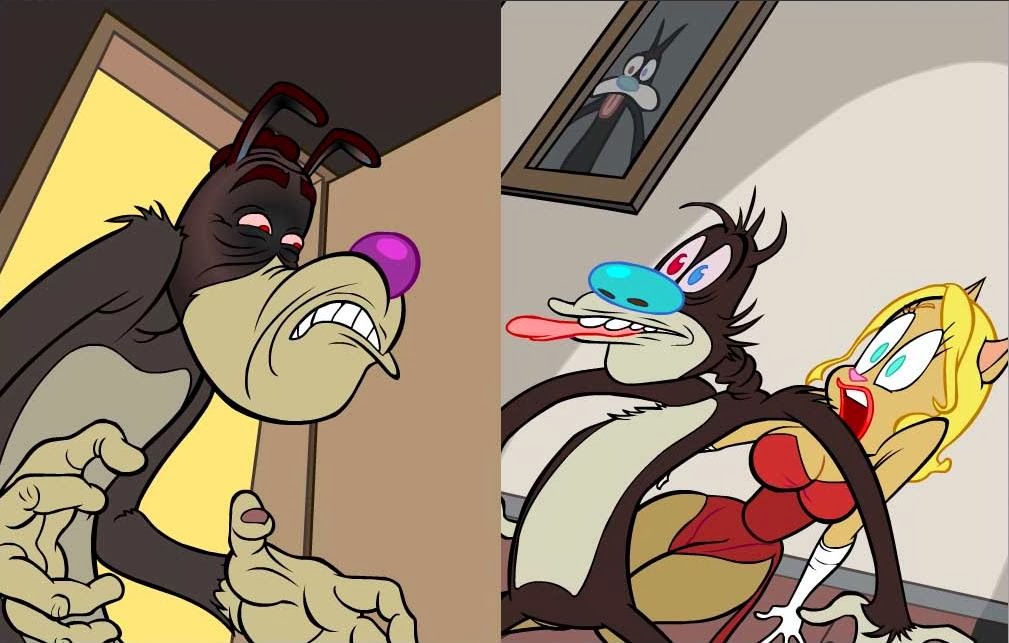
Spümcø Attack!


Saturday, October 5, 2013

47 Ronin - And the Keanu factor


What do you want from me? Nobody’s perfect.
I’ve always been a junkie for samurai fantasy adventures circa early 1980s (Ninja Wars Legend of the Eight Samurai) so to see Universal backing one, with a first-time director at the helm no less, and with all the production design and modern FX spectacle a hefty $175 million can buy is the kind of Hollywood foolhardiness I can get behind. Add to the absurdity Keanu Reeves. Any other white actor in the lead would have likely proven disdainful to the Japanese born source material, but Keanu is the exception: he is beyond any known race. I’m not just referring to his multi-ethnic ancestry, but his artfully dopey, live-action anime, surfer-mystic, rock star incarnate screen persona that could only exist in movies. It’s Keanu’s particular ingenuousness that makes casting like this work, that he’s clearly playing the part so doggedly and sincere.
The worst thing this movie can do is short-change its own goofy potential. All the elements in place, what it needs in order to succeed is to just be, like, "Fuck it!" and go all-out; to fully embrace it’s 'magic and monsters' conceit with reckless abandon; to be as wild, ridiculous and over-the-top as possible. Assuming it lives up to the trailer, what's not to like? I mean, shit, there’s gonna be pirates and ogres and witches and fireballs ...and Neo with a glowing katana. I’m in. Hell, I might even see it opening day, as a Christmas present to myself. 
Merry Christmas, Cannon.


Monday, August 26, 2013

Which Are You?

Presented before you are three separate options: Enhanced, Normal and Known Traveler. Such is a choosing of fundamental proportions.


He who deems himself Enhanced will face the world with the means (whatever they may be) greater than that of the average man, but will likewise be facing the expectations of said world, one that will challenge him accordingly. If he is in fact not Enhanced but merely chooses boastfully, ever harsher the reality he will face via crushing defeat. Or, perhaps, the self-confidence of choosing Enhanced without actually being so might nevertheless enhance such a man in the processes, all the same. Therefore, be careful not to choose in self-doubt.

He who deems himself Normal will disappear--disappear into the normality of the world, blending in with the rest, safely, comfortably. Yet, then again, such anonymity could be the very point; the perfect way to hide one’s ulterior motives. What if there is no Normal? What if every man who chooses Normal is anything but? All of them, tricksters, deceivers, agents of chaos. Imagine an army of Normal, an army behind white picket fences. Is Normal not the ultimate Weird?

He who deems himself Known Traveler must, by definition, be a man of identity. Or is he a man seeking identity? To presume the Known is to presume the Unknown. Does this gateway only accept those who have since solidified their existence to the world or does it also grant one such recognition? A metamorphosis: invisible into visible, ghost into living, not to be ...to be. In any event, it is my guess that a Known Traveler never settles. He travels not merely to be known, but to be all-knowing.


Wednesday, August 21, 2013

Subway Blonde


Suspension of Disbelief

 
Click for enlargement ...and enlightenment.